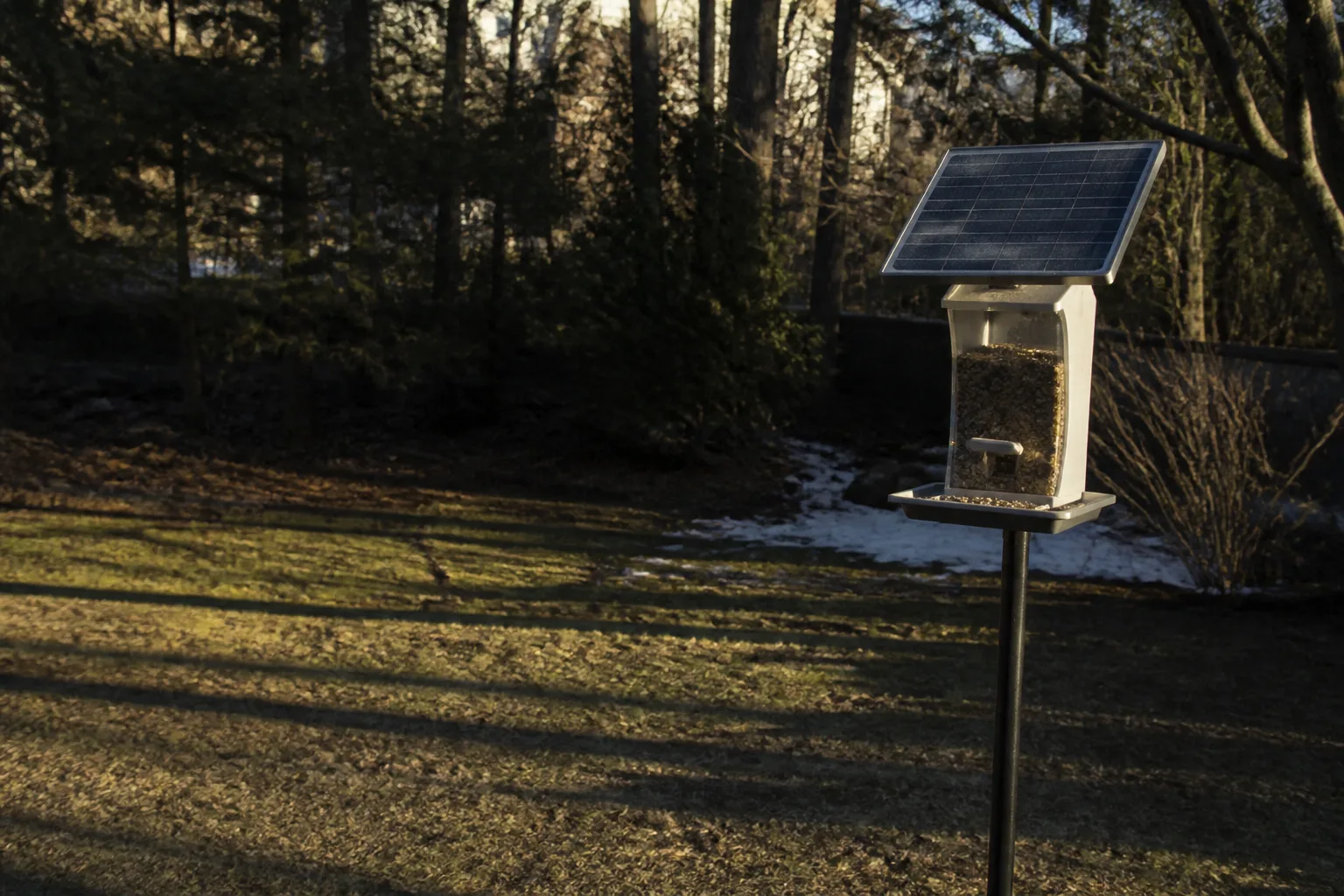
1. The marketing says months; the first winter says days
Camera bird feeders are sold on three numbers: the resolution of the camera, the size of the seed bin, and the battery life. The first two are true. The third is “true, on average, in conditions that the marketing department wrote the press release in.” The 2026 roundup consensus is short on this: solar-assisted feeders last “4–6 months in ideal conditions” and “days in heavy use or cold.” The Bird Buddy Pro Solar's real-world data, cited across the roundups, lands in that same range — months of standby, days of activity. (checked 2026-08-23).
The honest summary for a beginner, before any number is named:
- Marketing's “months” is the standby number. No motion events, no night vision, no cold weather. Useful as a ceiling, not as a plan.
- The honest day-to-day number is closer to the “days to weeks” range. In moderate weather, with normal bird activity, a solar-assisted feeder will go roughly 4–8 weeks between hand charges, per the 2026 roundup consensus.
- Cold weather is the part the marketing does not name. Below freezing, with night vision active and motion events firing all day, a feeder that gets full sun can still go flat in 2–5 days. Hypothesis (checked 2026-08-23): the gap between the marketing number and the cold-weather number is the single most common “my feeder died” complaint in the camera-feeder forums.
There are no affiliate links on this page. The pick between solar-assisted and not lives on the flagship guide and the comparison page; the rest of this page is the power math so the pick is an informed one.
2. The system: panel, battery, camera — name the parts
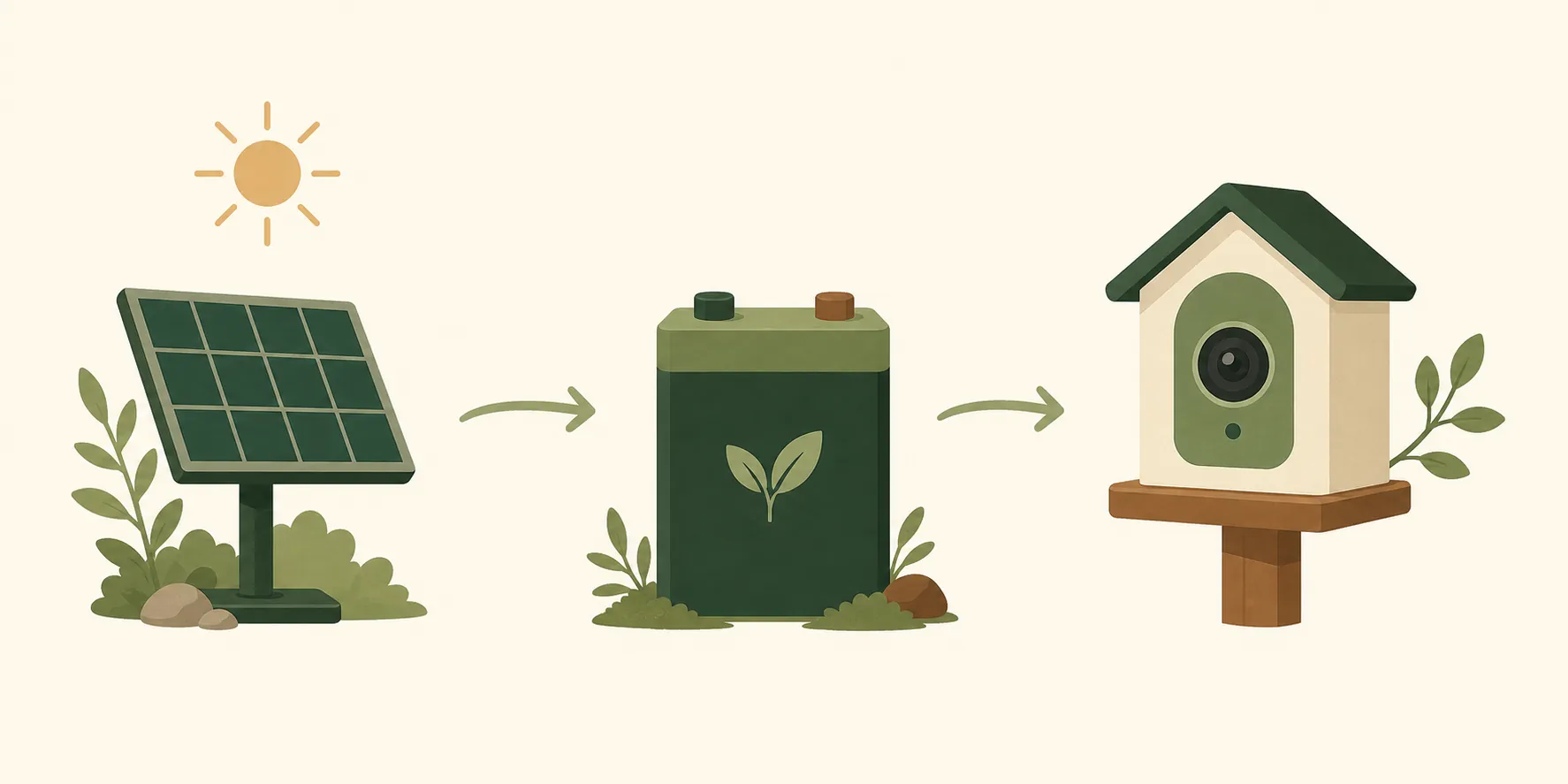
Before the marketing and field numbers can be compared cleanly, it helps to name the three parts of the power system. Most 2026 camera feeders use a solar panel that charges a small onboard lithium battery, and the battery runs the camera, the Wi-Fi radio, and the night vision. The three numbers that show up in the spec sheet, and what they actually mean, are below. All numbers are checked 2026-08-23.
Panel size — 5W is the standard. The 5W panel is the size that fits on the back of a feeder-sized housing and is enough to keep a battery topped up in direct sun, per the 2026 roundup consensus. Smaller panels (2–3W) appear on budget models and add real solar-charging limits in cloudy weather. Larger panels (8W+) are rare and overlap with the “outdoor camera” form factor, not the feeder form factor.
Battery size — the 5,200–9,000 mAh class. The 5,200 mAh battery is the standard for the budget tier; the 9,000 mAh battery (Birdfy 2 Pro Solar) is the higher end of the 2026 range. The math: a 5,200 mAh panel recharges in roughly 8 hours of direct sun, per the 2026 hardware roundups. The 9,000 mAh unit is the same panel-to-capacity ratio, scaled up — longer run time, longer charge time, similar percentage of useful sun per day. Fact (checked 2026-08-23).
Camera and radio — the part that drains the battery. The solar panel tops the battery up during the day. The camera, the Wi-Fi radio, and the night-vision IR LEDs drain the battery when the feeder is awake. The ratio that matters is not the panel size, and not even the battery size in isolation — it is the average current draw against the average daily charge. The rest of this page is the four things that drive the draw up.
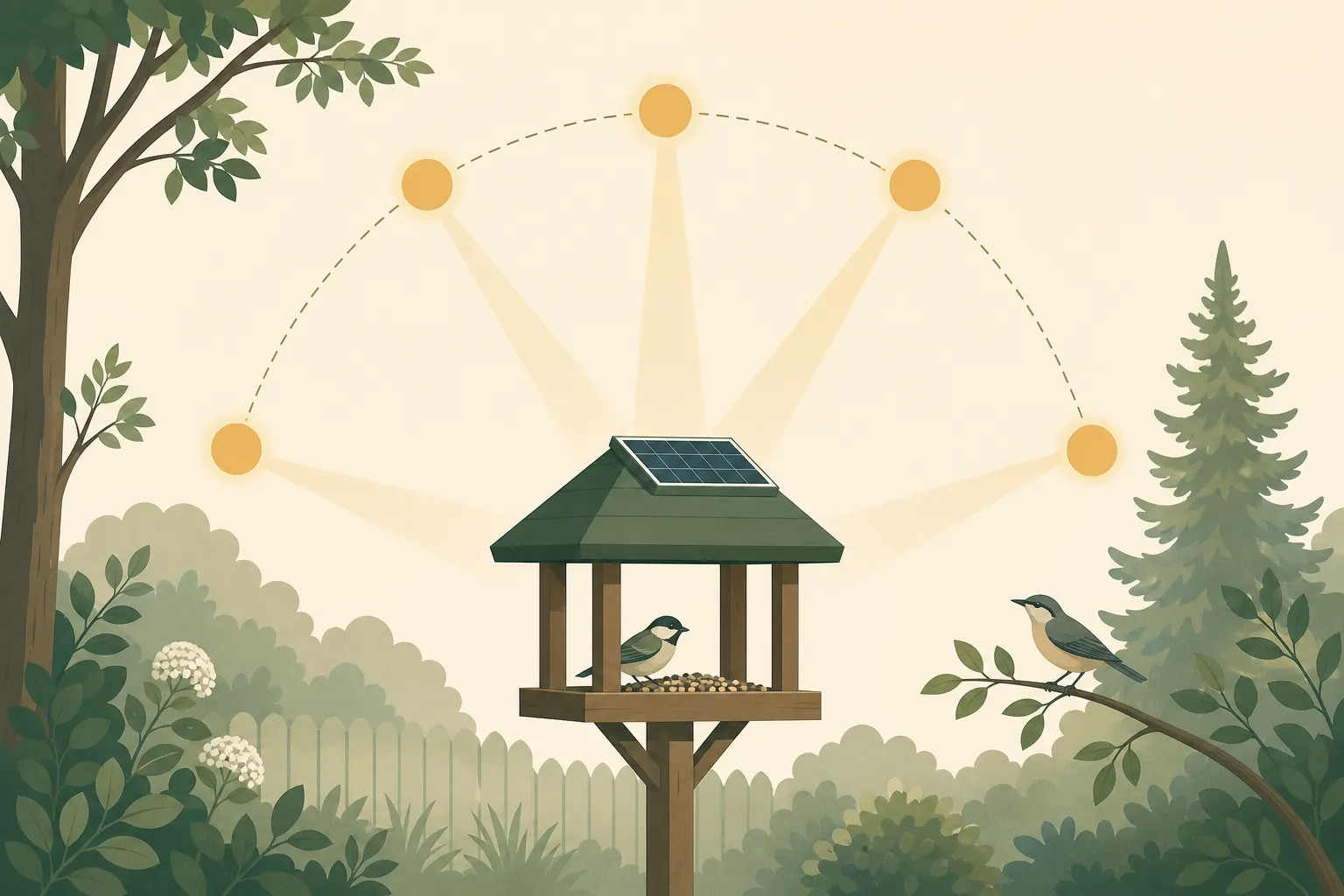
The number on the spec sheet a beginner should remember is the 5,200 mAh / 5W / 8 hours of sun. That is the baseline. Anything that moves a feeder away from that baseline — shade, motion spam, cold weather — moves the actual run time down from the marketing ceiling.
3. What drains: cold, night vision, motion spam, weak signal
Four things drive the camera's current draw up. None of them are secrets; all of them show up in the 2026 roundup consensus. The honest version of the power page names them on the page, in this order, with the data attached.
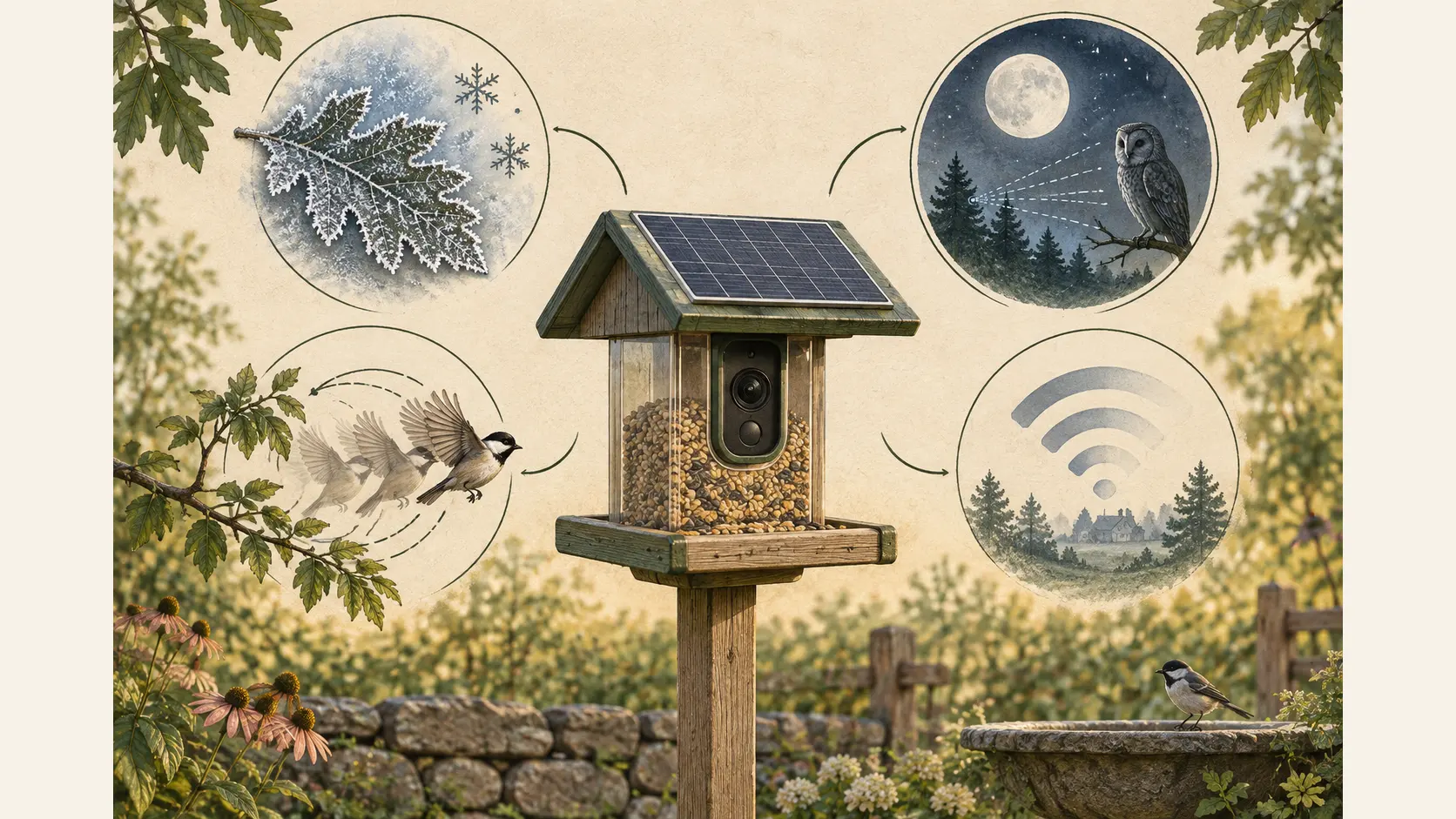
Cold weather. Lithium battery capacity drops as the cell gets cold. A 5,200 mAh cell at 70°F delivers close to its rated capacity; the same cell at 20°F delivers 60–80% of that capacity, depending on the chemistry. The 2026 hardware roundups cite the drop as the single largest field-vs-marketing gap. Fact (checked 2026-08-23). The honest addendum: the marketing number is the room-temperature number.
Night vision. The IR LEDs that light up a dark scene draw a steady current for as long as the camera is awake in low light. A feeder that wakes up at dusk and stays awake until dawn, with motion events firing all night, can spend more energy on night vision than on the camera itself. The 2026 roundup guidance is to expect night vision to be a larger share of the daily budget in winter, when nights are longer.
Motion spam. Every motion event wakes the camera, the Wi-Fi radio, and the AI, and uploads a clip. A feeder aimed at a windy branch or a busy street can fire hundreds of events per day. The 2026 roundup consensus is that motion spam is the most common cause of “the camera is supposed to last months and mine lasts days” complaints, and the fix is moving the camera so the field of view does not include moving vegetation or a sidewalk.
Weak signal. The Wi-Fi radio draws more current when it is at the edge of range than when it has a strong connection, because it retransmits. A feeder that passed the phone test at the mount spot but is at one bar, not three, is using more power to stay connected than the spec sheet assumes. This is the part of the mounting and Wi-Fi page that ties back to power: the Wi-Fi test is a power test, not just a connectivity test.
The four drains stack. A feeder in a windy spot, at the edge of the Wi-Fi range, in partial shade, in the cold months, will not hit the marketing number. Any one of those on its own is a 20–30% drop; three or four of them at once is the gap between “months” and “days.”
4. Honest expectations by season
The research-based number a beginner can carry around is a season-by-season range, with the source attached and the limits labeled. The 2026 roundup consensus is that real-world data is thin enough that exact numbers should be labeled as ranges and as hypothesis when the source is forum threads rather than lab data. The numbers below carry that label explicitly. (checked 2026-08-23).
Ideal conditions — moderate temperatures, low activity, direct sun, stable Wi-Fi. Marketing's “months” lives here. A 5,200 mAh / 5W feeder with weekly events and a clean signal can run 4–6 months between hand charges, per the 2026 hardware roundups. Fact.
Heavy-use conditions — moderate temperatures, daily events, partial shade, no night vision. The realistic number is 4–8 weeks. Fact (roundup consensus, 2026-08-23). This is the most common operating range for a beginner with a feeder in a working spot and a steady stream of birds.
Winter conditions — below freezing, long nights, daily events, weaker sun. The realistic number is 2–5 days on a single charge, with hand-charging needed in stretches of cloudy weather. Labeled hypothesis (2026-08-23): the upper end of the range is the one a partial-shade feeder in the south of the country will see; the lower end is the one a north-facing, shade-spotted feeder in the north will see. The Bird Buddy Pro Solar data, cited across the roundups, lands in this band.
Bad-case conditions — below freezing, full night vision, motion spam, weak signal. The marketing number stops being useful here. Expect to charge by hand every 1–3 days. Labeled hypothesis (2026-08-23): this is the part of the year the marketing does not name, and the part a beginner is most likely to be caught out by.
There is no one number that is honest. There is a range, with conditions attached, and a beginner who plans for the lower end of the range will not be surprised by a flat battery in the second week of January. The plan: know the spot's sun path before mounting, run the Wi-Fi test before drilling, and budget for hand-charging in the months the marketing page does not name.
5. Placement for sun without wrecking the Wi-Fi spot
Sun and Wi-Fi are not always the same direction. The honest part of the placement decision is the part where the page says so out loud, and then names the parts that are not in tension.
The sun path for a 5W panel is forgiving: a few hours of direct sun per day is enough to keep a 5,200 mAh battery close to full. The Wi-Fi spot, by contrast, is finicky: a 2.4 GHz radio at the back fence is a different problem than a 2.4 GHz radio at the back porch. The mounting and Wi-Fi page covers the test in detail. The summary that lives here: a feeder that gets morning sun, then shade in the afternoon, will charge fine; a feeder that is in full afternoon sun with a strong Wi-Fi signal is the best of both worlds. A feeder that is in deep shade all day, even with a strong signal, is the worst of both worlds, because the panel never catches up.
The placement rules, with the sun-and-signal tension named:
- Sun first. The solar panel is the part that is hardest to fix later. A feeder in deep shade can be moved; a panel that has been undersized from day one stays undersized.
- Wi-Fi second. The 2.4 GHz radio is a more flexible problem because the answer can be a mesh node, a moved router, or a closer spot. Hypothesis (checked 2026-08-23): most beginners solve the Wi-Fi problem by moving the feeder or the router, not the sun problem.
- The 10 ft from cover rule still applies. The same Cornell guidance the mounting and Wi-Fi page uses for bird safety is the same rule that keeps a feeder out of deep permanent shade, because a feeder 10 ft from a shrub is also 10 ft from a permanent shade cast.
- One full day of watching. Before drilling, watch the mount spot for a full day. Morning sun and afternoon shade, or vice versa, is fine. No sun all day is not.
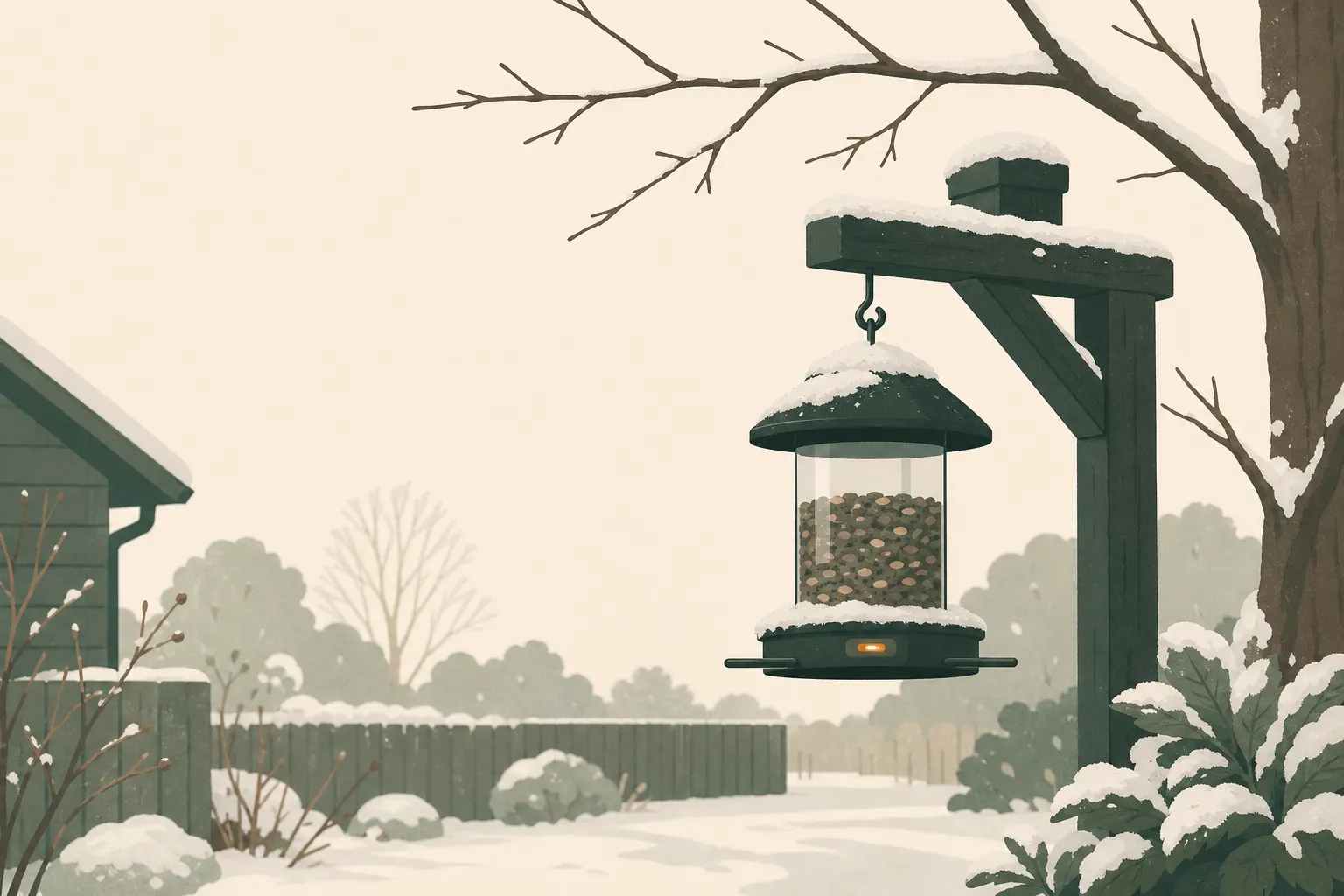
The sun-and-signal tension is also the answer to a question the subscriptions page raises: a feeder that has to be plugged in and hand-charged weekly is a different cost-of-ownership story than the marketing summary. The subscription fee is the same either way; the hand-charging time is not.
6. Limits
The limits on this page belong on the page, not in a footnote:
- Research-based, not hands-on. I have not yet installed a feeder in my own yard. The numbers above are the consensus across the 2026 roundup guides and the Bird Buddy real-world data, all dated 2026-08-23. Field notes from my own first installation will go on a separate page when they exist, and this page will be refreshed against them.
- Season ranges are labeled, not measured. The 2–5 day winter range is a hypothesis, not a measurement. The Bird Buddy Pro Solar data lands somewhere in that band, per the 2026 roundup consensus, but the specific number for a given yard is a function of shade, signal, and activity that the page cannot know.
- The 5,200 / 5W / 8 hours of sun baseline is for direct sun. Cloud cover, partial shade, and a north-facing panel all reduce the “useful sun” total. The math is honest; the application is yard-by-yard.
- No income claims, no subscription numbers here. The subscription tiers and the SD-card option are covered on the subscriptions page, with a pre-checkout checklist for running one without a monthly fee. The two pages agree on the dates and the evidence base.