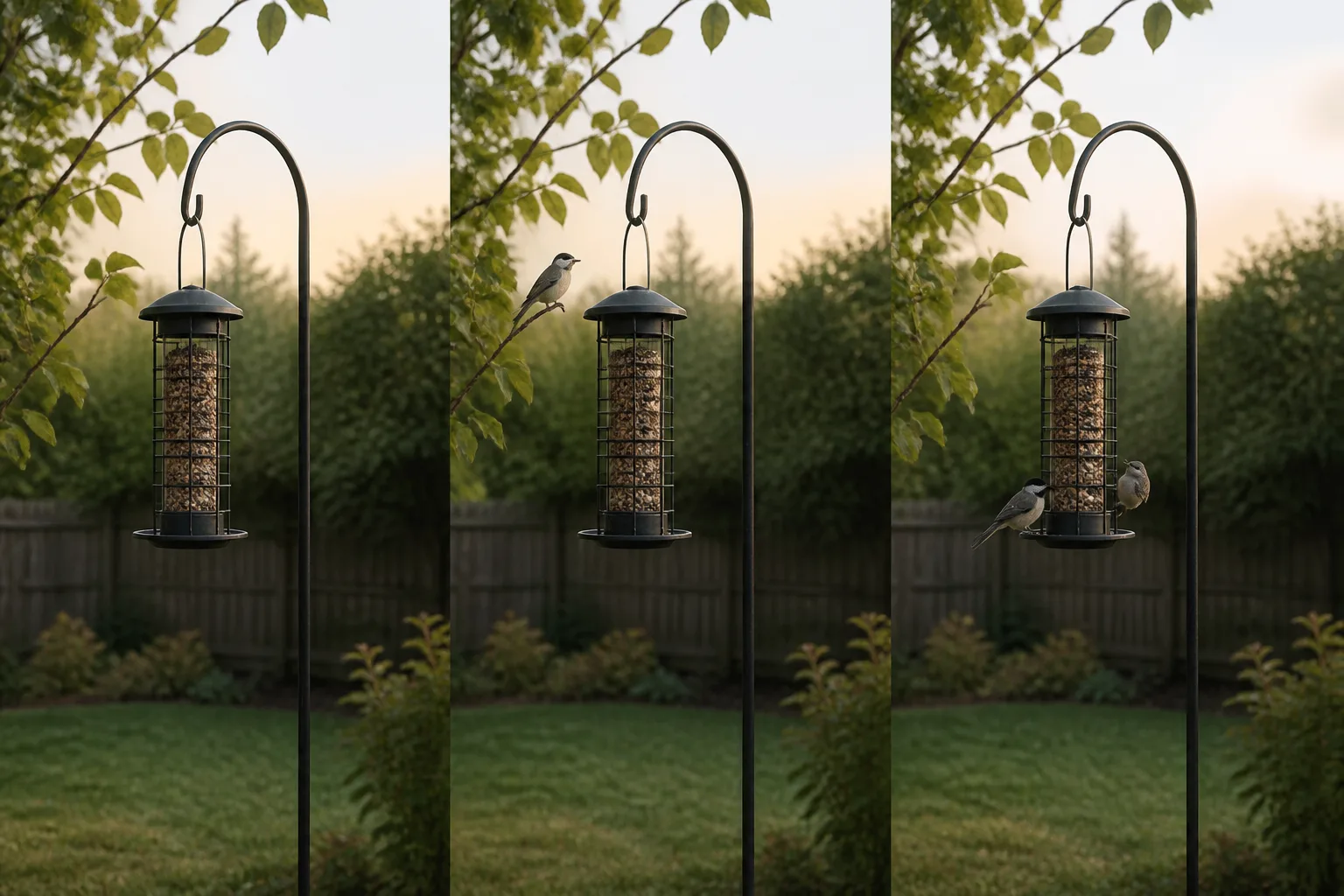
1. The camera is ready; the yard is empty — that's normal
The product page suggests birds in your inbox by sundown. The honest answer, agreed across the 2026 roundup consensus and the manual “acclimation” sections, is that an empty yard on day one is the rule, not the exception. Birds need to find the feeder, recognize it as a food source, and accept it as safe. None of those steps are instant. A feeder that has been up for three days and shows zero visitors is a feeder that is on schedule.
Three things are happening in the first week that the camera does not see:
- Discovery. Local birds fly a fixed route through their territory. A new feeder is a small object on a small pole; it does not announce itself. Discovery usually takes 1–3 days for a feeder in a yard that already has bird activity, per the 2026 roundup consensus.
- Inspection. The first birds that find the feeder will perch on a nearby branch, then on the feeder itself, then leave without eating. Inspection is the part the manual means by “acclimation,” and it usually takes 1–2 days. Fact (checked 2026-08-23).
- First visit. The first actual feed is the part that appears in the app, and it can be a single bird eating alone for 30 seconds, then leaving. That is success.
The feeder picks live on the flagship guide and the comparison page; the only affiliate link here is on the starter seed named in section 3, marked inline. The rest of this page is the seed, the placement details, and the realistic timeline.
2. The acclimation timeline: days, weeks, and the “don't change anything yet” rule
The research-based timeline a beginner can carry is a 2–3 week arc, with the “don't change anything yet” rule running through the middle of it. The 2026 roundup consensus, cross-checked with the Cornell All About Birds feeder-acclimation guidance, lands on the same numbers. All dated 2026-08-23.
Days 1–3 — discovery window. The feeder is up, the seed is in, the app is running. Expect zero or very few visitors. This is the normal first-3-days, not a feeder problem. Fact.
Days 4–7 — first regular visitors. The first birds find the feeder, inspect, and start feeding. The first regular visitors are usually house sparrows, house finches, or black-capped chickadees, depending on region; the 2026 roundup consensus and Cornell agree this is the species-mix default. Fact.
Weeks 2–3 — regular use. The feeder becomes a routine stop. The “2–3 weeks to regular use” line shows up in the 2026 hardware roundups and the manual acclimation sections. Fact (checked 2026-08-23). By the end of week 2, the app should be busy enough that the AI species ID is the bottleneck, not the camera.
The rule that runs through all of this: do not change anything for the first two weeks. The most common beginner mistake is moving the feeder on day 4 because “nothing is happening,” which restarts the discovery clock. Wait two weeks before changing the seed, the location, or the mount height. Fact (checked 2026-08-23): the manual acclimation sections on the 2026 roundups all say some version of this; the manual for the budget and the manual for the premium tier agree.
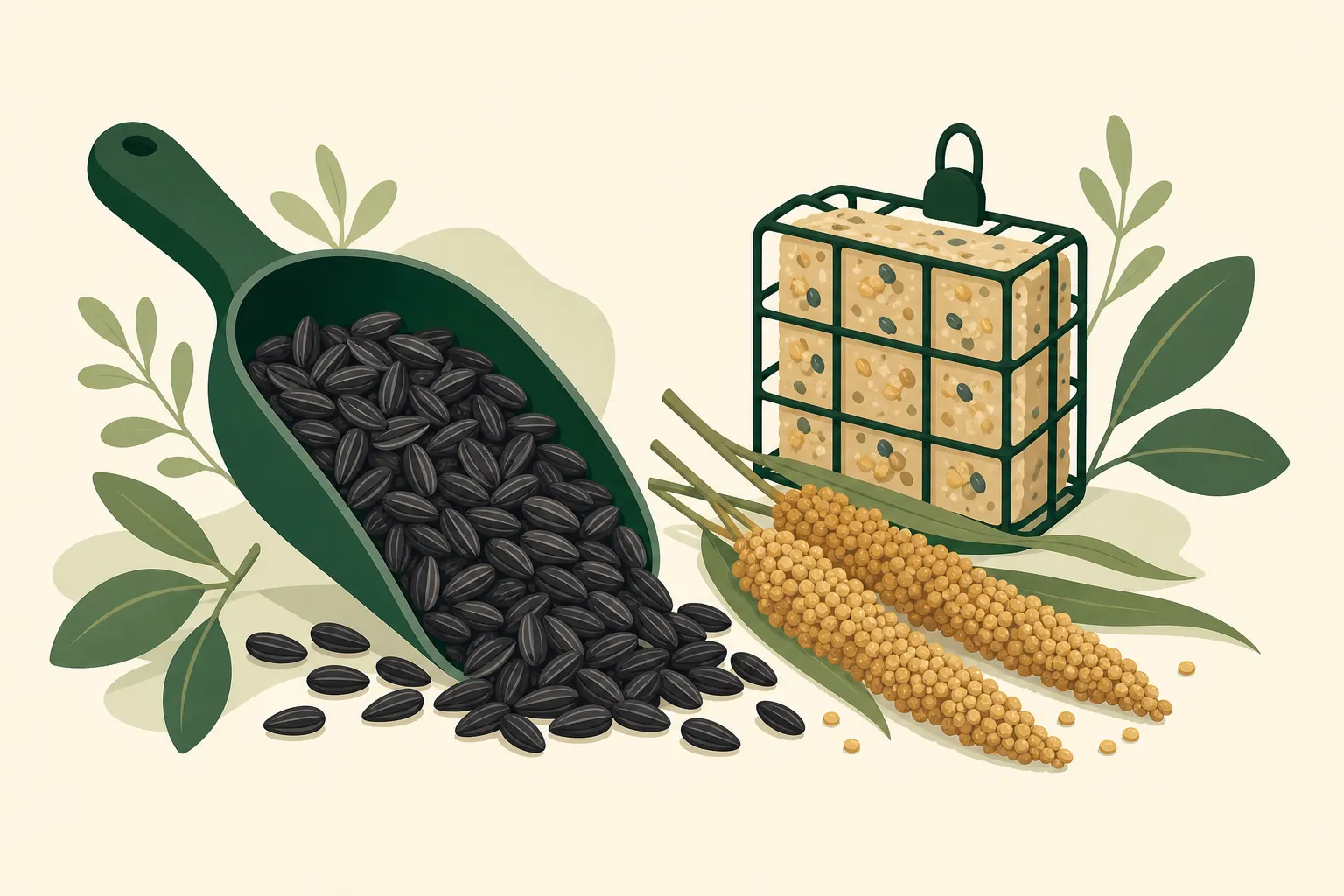
The acclimation timeline and the “don't change anything for two weeks” rule are the two pieces of the birding side of setup that the marketing page does not name. The product page says “minutes to install.” The honest page says “days to first visitor, 2–3 weeks to regular use.”
3. Seed: black-oil sunflower as the standard starter
The seed question is shorter than the marketing makes it look. Across the 2026 buyer’s-guide roundups and the Cornell All About Birds feeder-seed guidance, the same first seed shows up: plain black-oil sunflower (for example, Wagner’s black-oil sunflower on Amazon, checked 2026-08-23). The pattern is consistent enough that a beginner who picks something else first usually ends up switching. (checked 2026-08-23).
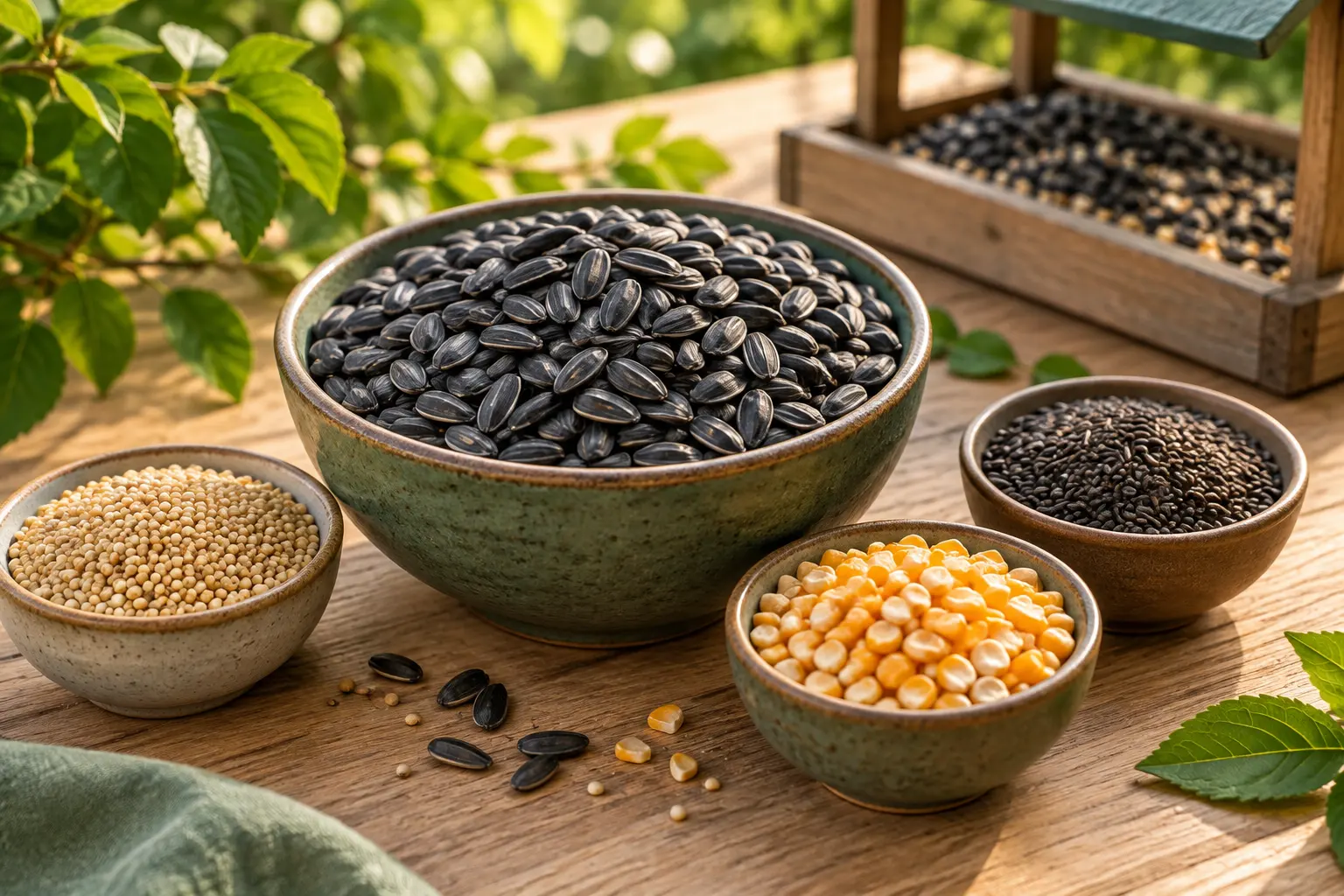
Why black-oil sunflower, in two short reasons:
- It is what the most-likely first visitors already eat. Cardinals, chickadees, titmice, house finches, goldfinches — the species the 2026 roundups call the most-likely first visitors all eat black-oil sunflower in the wild and at feeders. Fact (roundup consensus, 2026-08-23).
- It is a practical first seed. Start with a bag size that fits your feeder and storage space. Add a second seed after the first month only if you want to test whether it changes which birds visit.
What to avoid on day one, and why:
- Mixed seed with lots of filler. Cheap “wild bird mix” often has milo, wheat, or cracked corn that the most-likely first visitors ignore. Squirrels and starlings do not, which means the feeder turns into a squirrel feeder in week 2. Fact (Cornell and 2026 roundup consensus, 2026-08-23).
- Nyjer on day one. Nyjer (thistle) attracts goldfinches and house finches, but the seed is small, expensive, and tends to clog cheap ports. Save nyjer for after the first month, in a separate finch feeder, if at all. Hypothesis (2026-08-23): a beginner who starts with nyjer often blames the feeder for the empty yard.
- Suet on day one. Suet attracts woodpeckers, nuthatches, and chickadees, but it is a separate feeder, a separate budget line, and a different placement. It is a month-two addition, not a day-one addition. Fact (Cornell, 2026-08-23).
The seed question is also a patience question. The right seed in the right place in week 1 still produces an empty yard, because the discovery clock is the bottleneck, not the seed. The seed choice matters most in week 2 and week 3, when the first visitors are deciding whether to come back.
4. Placement revisited for birds: cover, sky, and reflections
The mounting and Wi-Fi page covers the Wi-Fi and the height. This page is the birding side of the same decision: the placement details that the Wi-Fi page does not cover. The two pages agree on every number, because the birding guidance and the roundup consensus agree.
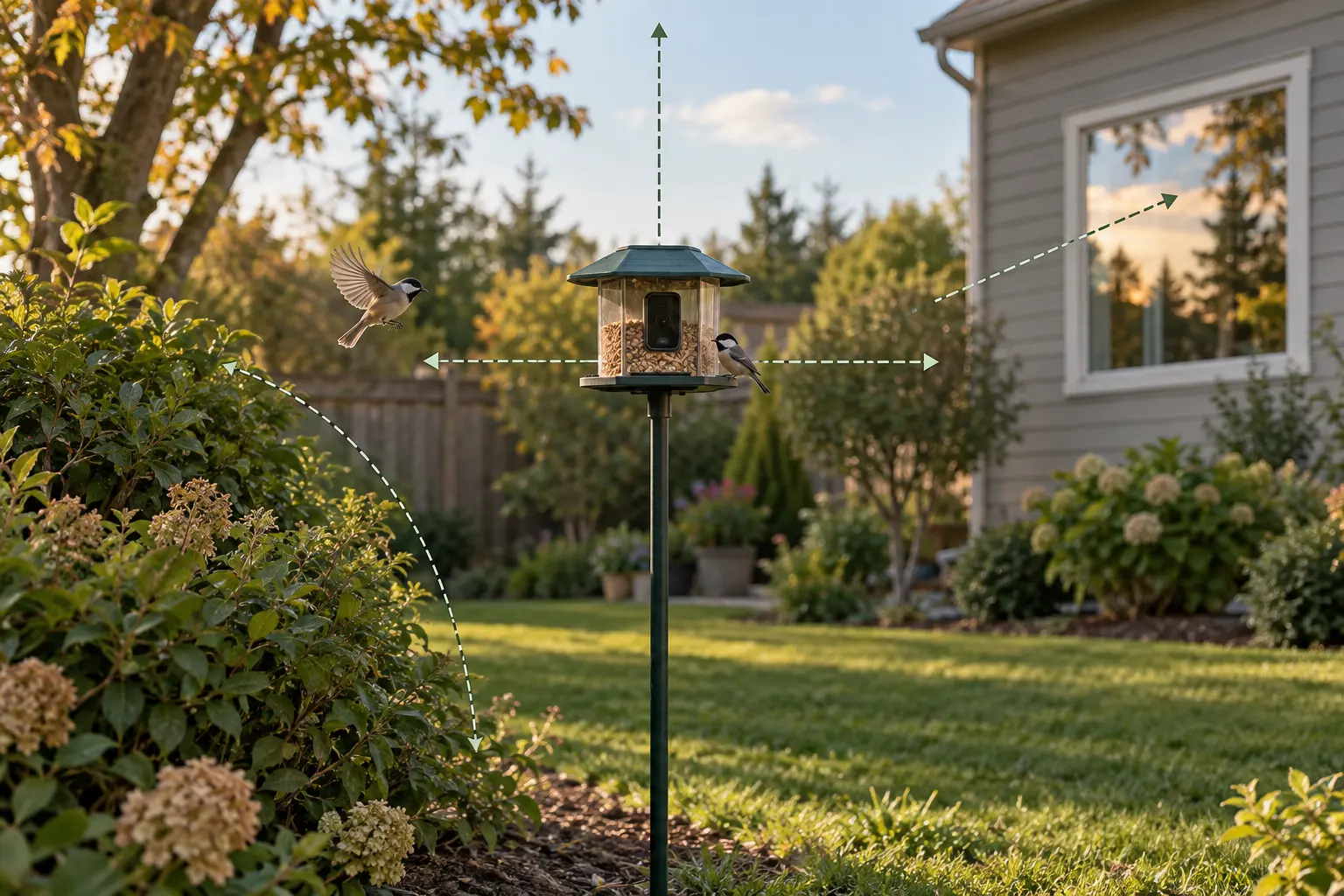
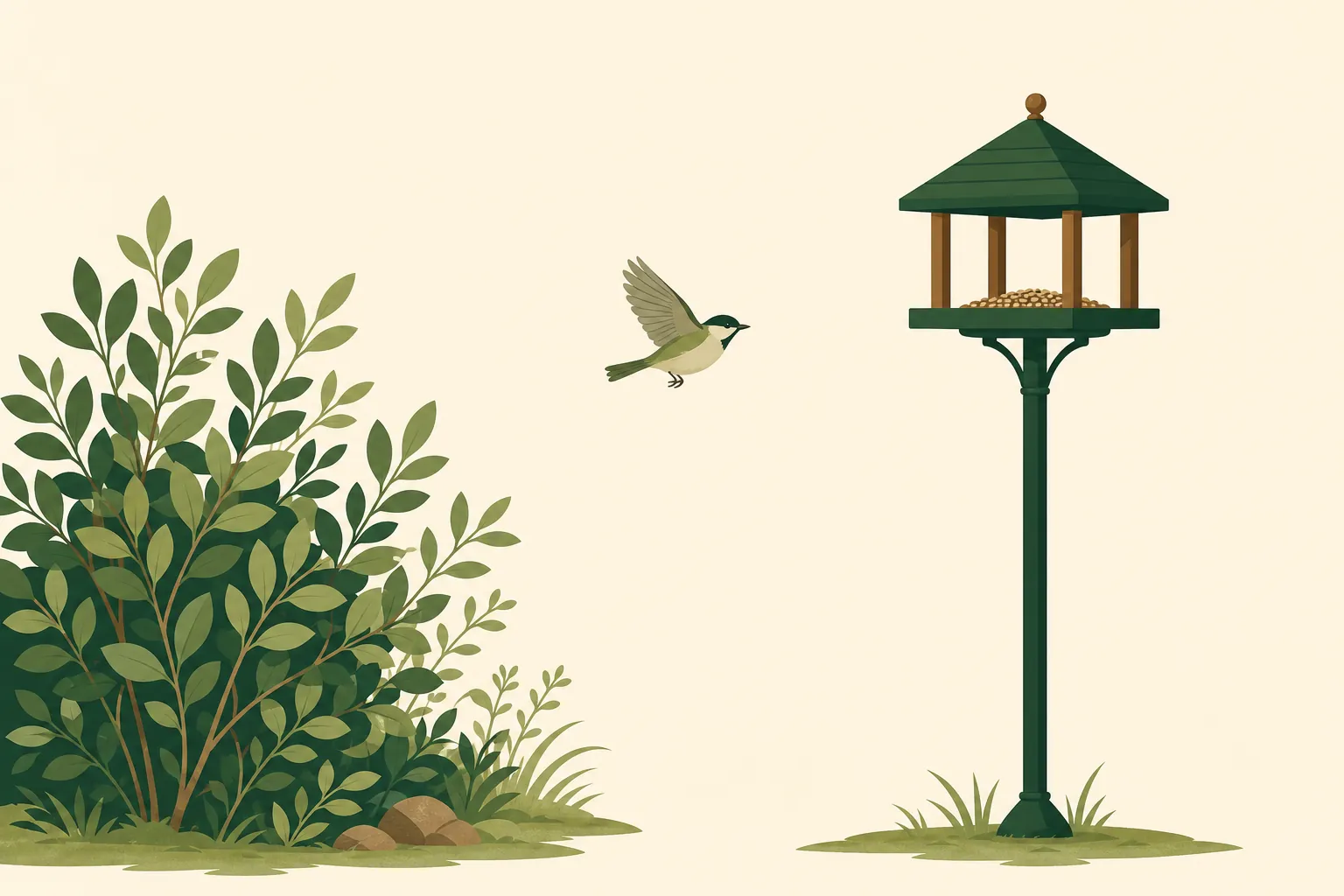
Distance from cover — about 10 ft, same as the Wi-Fi page. Cornell's All About Birds guidance puts a feeder roughly 10 ft from the nearest shrub or tree branch a predator could launch from. The number is the same on the Wi-Fi page (where it is the birding-safety floor) and on this page (where it is the predator-safety floor). Fact (checked 2026-08-23).
Visible from the sky, away from a perch-and-dive ambush. A feeder under a single tree is a feeder that the local hawk notices. A feeder that is in the open with a small shrub 10 ft away is a feeder that a small bird can dart to and a hawk has to cross 10 ft of open lawn to reach. The 2026 roundup consensus is short on this: a feeder that is “tucked into cover” is a feeder that does not get repeat visitors. Fact (checked 2026-08-23).
Away from window reflections. Cornell's window-collision guidance puts feeders either within 3 ft of a window (so a startled bird cannot build up flight speed before hitting glass) or more than 30 ft from a window (so the reflection is dim). The middle range — 4–30 ft from a window — is the range where window strikes happen most. Fact (Cornell, 2026-08-23).
One feeder, not three. The 2026 roundup consensus and Cornell both note that a beginner with one feeder in a good spot will get more visitors than a beginner with three feeders scattered across the yard. A single feeder is easier for the local birds to find, and the AI species ID works better on one busy feeder than on three quiet ones. Fact (roundup consensus, 2026-08-23).
5. Squirrels: the 5-7-9 refresher, with honesty about “defeat-proof” claims
The mounting and Wi-Fi page covers the 5-7-9 squirrel clearance rule (5 ft off the ground, 7 ft sideways from a jump-off, 9 ft below an overhanging branch) and is honest that a motivated squirrel can solve any static rule. This page is the follow-up: what the marketing and the roundup consensus do and do not promise about “defeat-proof” squirrel protection. All dated 2026-08-23.
The honest summary, in three short rules:
- The 5-7-9 numbers are a starting point, not a wall. Cornell and the 2026 roundup consensus both use the 5-7-9 rule as a starting point for placement. Fact. The page that calls the numbers a guarantee is the page to be suspicious of.
- A baffle is the part that holds the line. A pole-mounted baffle, a hanging baffle, or a feeder with a built-in baffle is the hardware answer that the static numbers do not provide. The 2026 roundup consensus is that baffle-equipped feeders lose less seed to squirrels than bare-pole setups. Fact.
- No feeder is “defeat-proof.” “Squirrel-proof” is a marketing label, not a measured result. Labeled hypothesis (2026-08-23): the brands that promise “defeat-proof” squirrel protection in advertising are usually the same brands whose 1-star reviews are about squirrels. Plan to refill occasionally, even with a baffle.
6. Limits + the patience contract
The limits on this page belong on the page, not in a footnote:
- Research-based, not hands-on. I have not yet had my own first visitor. The numbers above are the consensus across the 2026 roundup guides and the Cornell All About Birds feeder-acclimation guidance, all dated 2026-08-23. Field notes from my own first installation will go on a separate page when they exist, and this page will be refreshed against them.
- The 2–3 week timeline is a research-based range, not a guarantee. Some yards get first visitors in 24 hours. Some yards take 4–6 weeks. The 2–3 week number is the consensus middle, and the 2026 roundup consensus is that the deciding variable is the bird activity already in the yard before the feeder went up.
- The “don't change anything for two weeks” rule is the most important rule on this page. Moving the feeder, switching the seed, or moving the camera in the first two weeks restarts the discovery clock. Wait two weeks. Fact (manual acclimation consensus, 2026-08-23).
- “Defeat-proof” is a marketing label. Plan for occasional squirrel loss, even with a baffle. The page that promises otherwise is the page to be suspicious of.
- Seed gets one dated example link; pole accessories stay link-free on this round. The example above is a starting point, not a ranking. The picks live on the comparison page and the flagship guide.
The patience contract, in one line: do not change anything for two weeks from the day the feeder goes up. The product page promises the first bird in minutes. The honest page promises the first bird in days and regular use in 2–3 weeks, and the only contract that holds is the two-week wait. Fact (checked 2026-08-23).